
Philanthropy
BEL Visiting Chair Professorship in Radar Systems
Bharat Electronics Limited • Ongoing

About
The BEL Visiting Chair Professorship in Radar Systems at IISc was established in 2009 and is a prestigious initiative designed to bridge the gap between academic research and industrial application in the field of radar studies. By fostering a close collaborative environment, the chair aims to master cutting-edge technologies across the entire lifecycle of radar development—from fundamental science and design to advanced manufacturing. This partnership not only strengthens the national leadership of both BEL and IISc in radar education but also seeks to establish a formidable international presence in state-of-the-art radar innovations.
Upcoming Lecture
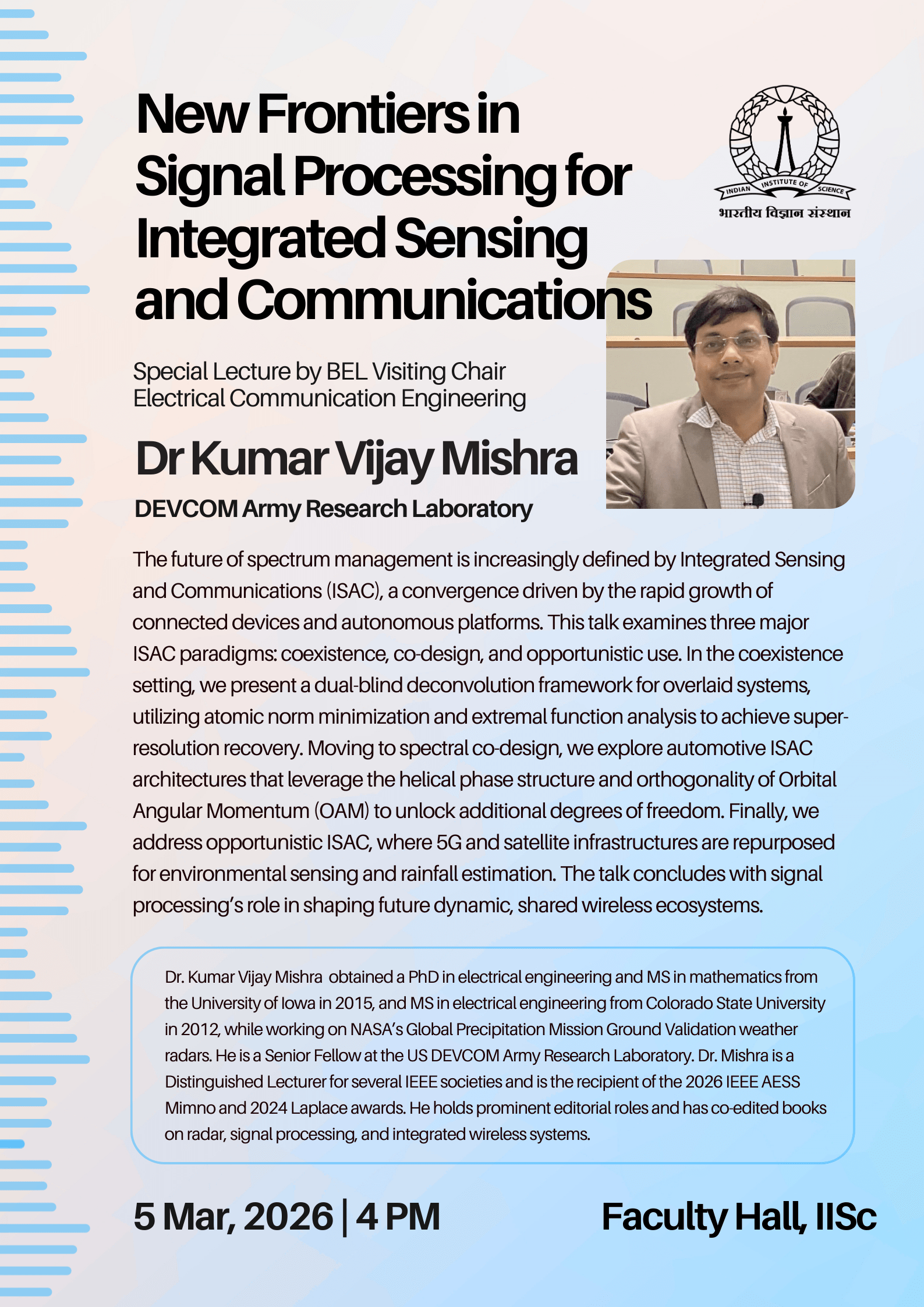
New Frontiers in Signal Processing for Integrated Sensing and Communications
The future of spectrum management is increasingly envisioned as shared, dynamic, and efficiency-driven. The rapid growth of connected devices, autonomous platforms, and bandwidth-intensive applications is pushing wireless systems toward a deep integration of sensing and communications (ISAC). From a signal processing standpoint, this convergence presents both fundamental challenges and exciting new opportunities.
In this talk, we explore representative advances across three major ISAC paradigms: coexistence, co-design, and opportunistic use. In the coexistence setting, we present a dual-blind deconvolution framework for overlaid radar-communications systems, where neither the transmitted signals nor the propagation channels are known. By leveraging atomic norm minimization, positive trigonometric polynomial theory, and tools from extremal function analysis, we establish super-resolution recovery guarantees under practical conditions.
Moving to spectral co-design, we examine automotive ISAC architectures and introduce the use of orbital angular momentum (OAM) to separate sensing and communication functionalities. By exploiting the helical phase structure and inherent orthogonality of OAM modes, the system unlocks additional degrees of freedom beyond conventional planar wavefronts.
Finally, we consider opportunistic ISAC scenarios, where existing communication infrastructures, such as satellite links and 5G base stations, are repurposed for environmental sensing. Applications include deep-learning-based rainfall estimation and distributed imaging without dedicated radar deployments.
The talk concludes with emerging research directions and broader reflections on how signal processing will shape the next generation of dynamic spectrum sharing and integrated wireless ecosystems.
Kumar Vijay Mishra (S’08-M’15-SM’18) obtained a Ph.D. in electrical engineering and M.S. in mathematics from The University of Iowa in 2015, and M.S. in electrical engineering from Colorado State University in 2012, while working on NASA’s Global Precipitation Mission Ground Validation (GPM-GV) weather radars. He received his B. Tech. summa cum laude (Gold Medal, Honors) in electronics and communication engineering from the National Institute of Technology, Hamirpur (NITH), India in 2003. He is a Senior Fellow at the United States DEVCOM Army Research Laboratory. He has served as the Distinguished Lecturer (DL) of several IEEE societies (ComSoc, AESS, GRSS, VTS, FNI) and Optica. He is the recipient of the IEEE AESS Harry Rowe Mimno Award (2026), SAE International Award for Excellence in Innovation (2025), IEEE Signal Processing Society Pierre-Simon Laplace Early Career Technical Achievement Award (2024), IET Premium Best Paper Prize (2021), U. S. National Academies Harry Diamond Distinguished Fellowship (2018-2021), Viterbi Postdoctoral Fellowship (2015, 2016), Lady Davis Postdoctoral Fellowship (2017), DRDO LRDE Scientist of the Year Award (2006), NITH Director’s Gold Medal (2003), and NITH Best Student Award (2003).
Dr. Mishra is Chair (2023-2026) of the International Union of Radio Science (URSI) Commission C, Chair (2025-) of IEEE AESS Technical Working Group on Integrated Sensing and Communications (ISAC-TWG), and Vice-Chair (2021-present) of the IEEE Synthetic Aperture Standards Committee. He is Editor-in-Chief (EiC) of River Rapids Series in Radar Systems, Signal Processing, Antennas and Electromagnetics (2025-), Editor (Deputy EiC) of Radio Science (2025-), Senior Area Editor of IEEE Transactions on Signal Processing (2024-), and Associate Editor of IEEE Transactions on Aerospace and Electronic Systems (2020-) and IEEE Transactions on Antennas and Propagation (2023-). He is the lead co-editor of several books on signal processing and radar: Signal Processing for Joint Radar-Communications (Wiley-IEEE Press, 2024), Next-Generation Cognitive Radar Systems (IET Press Electromagnetics and Radar Series, 2023), Advances in Weather Radar Volumes 1, 2 & 3 (IET Press Electromagnetics and Radar Series, 2023), and Handbook of Statistics Volume 54: Multidimensional Signal Processing (Elsevier, 2026). His research interests include radar systems, signal processing, remote sensing, and electromagnetics.
Awardees
Nomination Procedure
- Well qualified/experienced & senior S&T academics/professionals in the broad field of radar are eligible for this position.
- The selection of a suitable person and his/her appointment to the Professorship will be made by IISc in accordance with the existing norms at the Institute.
- The term of appointment will be normally three years at a time, with the possibility of renewal for further terms on an appropriate review.
Benefits
- World-class collaborative research in a topic of mutual interest leading to high impact, guide younger colleagues/ students and strengthen this area.
- An Institute-level lecture on a cutting-edge topic.
- Increased monthly salary and allowances in a higher slab.